Tuesday, May 10, 2011

Have you seen this bee?

A neuroscience center in Scotland is looking for their bees, after four bee hives were stolen from their labs today, according to Reuters.

One scientist is quoted as saying "Clearly whoever did this knows what they were doing and how to handle bees."

Have you seen me?
So beekeepers of the world, beware.  There are bee-nappers out there who are skilled, prepared, and apparently stealthy.  I can only imagine what sort of rig you'd need to steal four hives' worth of bees, much less what kind of motivation.  

Dr. Chris Connolly, the lead researcher of the project, speculated that the bees might have been pilfered for breeding purposes, or to be sold to specialty beekeepers. They're estimated to be worth about $3.3 million dollars.  

I'm kind of hoping this turns into a hostage situation.  A ransom note will appear at the lab, written in honey.  Connolly will talk to the bee-nappers over the phone, and he'll demand to talk to one of the queen bees to confirm that she's okay.  The bees will quietly plan an escape, and that one charismatic super-bee will organize the others, engaging in hand-to-hand combat with the lead bee-thief, risking her life as her sister-bees flee to safety.  She'll be wounded and weakened, but she'll live!  

Paramount pictures must surely already be working on the script, and I for one can't wait to see that movie.  


Tuesday, April 26, 2011

Crowd-Sourcing Safety?

Guards in protective gear near the
Fukushima-1 nuclear plant's main gate,
Al Jazeera news reports that a group of techies involved with the Toyko HackerSpace are heading a project to make information about radiation levels in northeast Japan more accurate and available to those living there.

Safecast.org has been handing out Geiger counters to residents and running them around the affected areas around the damaged Fukushima Daiichi plant.  The information is updated to the website, which aggregates data from government agencies and charity organizations who are also watching radiation levels.

The goal is to provide information that is more transparent, regularly updated, and localized than is currently available.  People in Japan are already living in perpetual uncertainty, not knowing whether another plate-tectonic  event is about to ravage what meager stability they have forged.  The inconsistent reports of radiation levels in the air, the food, and the water leave people essentially making decisions blind.  

There's a lot that could be said about the responsibility of government in disaster situations.  The problem in Japan doesn't just amount to a lack of government response - it's also an issue of transparency.  Numbers that are reported are hard to contextualize because the radiation-measuring process isn't clear and residents have no way to fact-check the information.  

Monday, April 18, 2011

The Embargo System

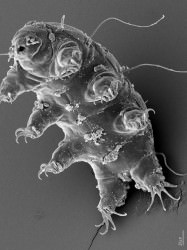
A water bear, crazy-looking
 but decidedly terrestrial.
Image credit: NASA.
Do you know where your science news comes from?

A lot of the most prestigious journals for scientific publications put out information in a cloak-and-dagger style known as the embargo system.  They select media outlets that they consider appropriate or legitimate enough for their purposes and send them information on upcoming publications.  The chosen media outlets get the info in advance of publication as long as they agree not to breathe a word to anyone until the embargo is lifted.

It's kind of an alien concept for a lot of journalists, and it can be pretty problematic for news in general.  In November of last year, the internet just about peed its pants over this NASA announcement:
NASA will hold a news conference at 2 p.m. EST on Thursday, Dec. 2, to discuss an astrobiology finding that will impact the search for evidence of extraterrestrial life. Astrobiology is the study of the origin, evolution, distribution and future of life in the universe.
Speculation about the discovery of ET ran pretty rampant.  Unfortunately, the journalists who knew the truth (that scientists had discovered a certain bacteria that could exchange phosphorus for arsenic in its DNA) couldn't quell the media clamor because they were sworn to secrecy.

Even worse, when the information went fully public, it seemed like a let-down.  Although the findings were significant and have implications for finding life in places once considered inhospitable, the truth didn't sound anywhere near as exciting as the rumors.

Ultimately the secrecy and hype did a disservice to science.  Maybe it's time we rethink the system.

Thursday, February 24, 2011

NASA's Robonaut 2 - Sophisticated Automaton, Evidence of Nerdery

NASA is currently counting down to space shuttle Discovery's final launch, but this notable last is also a first.  The crew aboard Discovery includes the world's first humanoid robot destined to be an active member of the ISS crew: the Robonaut 2.  That's right.  It's R-2.

But this R-2 is much more dexterous and only slightly less adorable than the Star Wars version.  And if NASA's images of the earth-bound Robonaut are any indication, space is about to get a little dorkier.  Here are some of my favorite images from the R-2's website and Flickr photostream:

Gotta beef up before launch, that torso-only spacesuit leaves 
little to the imagination. 


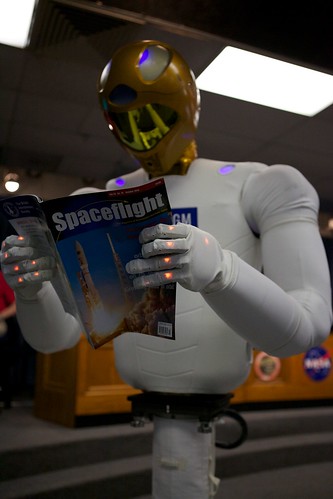
R-2, you're so vain.  I bet you think that article is about you.
(note: it is)

Yeah, being an advanced robot is alright.  But check out this sweet smartphone.
 (note: R-2 maintains its own Twitter feed)
An earlier version of the Robonaut. His hatred for the Jedi is
only mildly assuaged by his shiny new ears.   
If you don't come down from there, we're blasting off without you.
(note: the chariot is for mobility on earth, only the torso is going to space.)


Tuesday, February 1, 2011

Nerd Wordles

If you haven't seen Wordles yet, it's definitely worth checking out.  It's a free web graphic creator that turns text into art. The interface is easy to use, and the results are fun and fascinating, whether you're probing trends in your dream journal or in the Wall Street Journal.

The idea is simple:  You provide the text, and the program creates an image that mashes all the words together based on how commonly they are used.  The larger the word appears in the graphic, the more often it showed up in the text.

Here are some wonderfully nerdy Wordles that I created.  You can see more under my Wordle creator pseudonym: Salamandarzu.

From Einstein's "The Meaning of Relativity," which is made up of three lectures Einstein gave at Princeton in 1921.

Wordle: Einstein: The Meaning of Relativity

From the transcript of the pilot episode of Star Trek Enterprise, "Broken Bow," which originally aired September 26, 2001.  In this episode, the crew first makes contact with the Klingons.

Wordle: Star Trek Enterprise, pilot episode

From a transcript of Richard Feynman's lecture, "There's Plenty of Room at the Bottom," presented to the annual meeting of the American Physical Society in 1959.  In this presentation, Feynman envisioned future progress at the nano-scale.

Wordle: There's Plenty of Room at the Botton


From the text of "The Hacker Manifesto," also known as "The Conscience of the Hacker," sometimes called the cornerstone of the ethical hacking movement.  It was written by a hacker who called himself "The Mentor," and was originally published in in 1986.

Wordle: The Hacker Manifesto, by the Mentor

The transcript of the final episode of Carl Sagan's Cosmos, entitled "Who Speaks for Earth." The episode originally aired in 1980.

(This image is housed on my blog ,
because I can't rotate it on Wordle.)

Thursday, December 9, 2010

The Foursquare Minefield

What's the best thing about social networking in the digital age?  Ease of stalking!

Let's take a look at Jessica G. and her Foursquare profile.  She has provided a photo, so I can recognize her should I see her.  She's the current mayor of the Boston University College of Communications, likely a student based on her age.  She's the mayor of 646 E. Brookside Lane,  a residential area in New Jersey (where she's also the major of a bagel shop), so this is likely her hometown and her family house.  Finally, she's the Mayor of "The 157," another residential area in Brookline, Massachusetts, much closer to school.  This is probably where she's living now.  Furthermore, she's listed it as a "gay bar," suggesting that the girl hugging her in her profile photo is probably her girlfriend.  

Thursday, October 14, 2010

Scientists Study Dog Anxiety, Everyone Makes Same Joke

If you’ve got a canine friend, you may ascribe to the belief that your dog feels happy when you come home, depressed when you leave, or sympathetic when you’re feeling down. Well, you may be right. Recent science suggests that dogs may be prone to optimistic and pessimistic tendencies, and researchers used principles from human psychology to test this hypothesis. In the words of dozens of like-minded news writers, for some dogs “the bowl is half-empty.”


In the study, headed by a team at Bristol University, test-dogs were trained with two food bowls, one empty and one full. The bowls were always kept in the same place in the test room, so that the dog learned to expect a full bowl in one corner and an empty one in the other corner. After the dogs had formed these expectations, they were placed in the room with bowls arranged at random locations. Based on how enthusiastically the dogs checked the bowls, researchers classified which dogs were more optimistic decision-makers. Basically, being excited, rather than indifferent, about an unknown element belies a tendency to expect a positive outcome, rather than a negative one.

Wednesday, October 13, 2010

From Emoticon to Emoti-bot

Mid-August of this year, the news feeds exploded with stories about the Nao robot and its ability to use emotional responses to interact with people. The little humanoid robot displays its feelings through physical postures, hunching its shoulders when it’s sad or opening up its arms for hugs when it’s happy.

It’s a fantastic technological development, and some would say a terrifying portent of our impending machine-based doom. But despite the promising work that the robot is doing with autistic children and the potential aid for the disabled, all I could think about while reading these articles what do they mean by emotions?


Live and Streaming - The Top 5 Science Streams

The internet age has given us access to so many vectors of useless information that some really amazing science sites go unnoticed. Luckily, I have noticed them for you.

These are the five coolest online scientific data streams, brought to you by Zu.

5. Ground Control to Major Tom

Space exploration may seem alien to you (ha!), but NASA’s Human Space Flight tracker brings it home by showing you the precise location of the International Space Station (ISS). If there were any manned (personned?) shuttles in orbit right now, you’d be able to track those too. The site provides you with the status of the ISS, as well as who’s on board and your next chance to catch a glimpse of it in the sky over your town.

Keeping Score: Games of the Future and the Future of Gaming (extra points for comments)

Games are successful if they can achieve one vital goal: to keep you interested. Loyalty is priceless in the game world, and it’s achieved via reward systems that give you just enough satisfaction to keep you engaged.

But reward systems aren’t isolated to games. They have played a part in our consumer reality for a long time. Jesse Schell, game designer and teacher at Carnegie Mellon’s Entertainment Center, is waiting for a game revolution to take over even the mundane aspects of our everyday lives.

He envisions a world where your toothbrush gives you points every time you brush, and a bonus for brushing for the recommended three minutes. Your health insurance can read your digital shoes for how much you’ve walked in a day, and gives you points for getting your heart-rate up. Your cereal box has digital games on the back, instead of word-searches or mazes, and the games link up through Facebook to rate you against your friends.

Friday, October 1, 2010

I Can Imagine this Experiment Ruining Relationships

In breaking news from the world of that-confirms-what-I'd-suspected and well-isn't-that-depressing, scientists have discovered a disparity between the physical shape of people's actual significant others and that of their ideal significant others. Researchers at the Institut des Sciences de l'Evolution in France performed an experiment involving 116 "human couples," and found that, on average, men preferred their women much slimmer, and women preferred their men slightly beefier.

In the tests, each participant was given two silhouettes to modify - one that represented themselves, and one that represented the body shape of their ideal mates.  Each member was granted freedom - no worried loved ones looking over their shoulders - to alter the ideal mate silhouette to whatever looked most attractive to them.  The researchers then took the dimensions of the idealized silhouettes and compared them against the measurements taken from the participants and their actual mates.  

The findings break down as follows:
  • The men's ideal mates were generally significantly slimmer and slightly taller, thus having lower BMIs (body mass index)
  • The women's ideal mates were slightly larger and a little taller, with similarly proportioned BMIs
The paper concludes that no one had just what they wanted, which isn't particularly surprising.  

(Dreamy.) 

What's troubling, however, is that the preferred silhouette that the men drew had an average BMI of 18.4, just below the cut-off for being officially underweight by the standards of the World Health Organization.  Women drew silhouettes with an average BMI of 23.5, well within range and for their partners.  

While the study can do little to tease out the cause of these disparities, it's easy to let speculation lead us astray.  There weren't many controls in the experiment, and there aren't other similar tests that compare both mate preference and mate choice, so it's hard to draw any solid conclusions.  

What the researchers did conclude is that mate preference is a poor predictor of mate choice.  Basically, you're not likely to end up dating the body of your dreams.  Perhaps it's best to focus your preferences on non-physical attributes then, eh?  

Thursday, September 30, 2010

In the Basement with Boston's BUILDSers

(The headline isn't a typo, it's just not a very good headline.) 

Walking in, it's pretty much what I expected; the room is crowded with college kids, hunched around tables and over computers, nose-deep in books or tearing apart electrical equipment. The walls have murals of sci-fi landscapes and old-style phone switchboards, and there are power tools and wires and metal cabinets just about everywhere you look. There are more females than I’d expected, and that's a pleasant surprise.

This is the headquarters of BUILDS, a workshop and research lab tucked away in the basement of Boston University's Math and Computer Science building.  While BU has more than 550 clubs, this one in particular has something that most clubs don't - freedom. BUILDS is one of the few student-organized, student-managed, student-directed clubs at BU.  While the club still has the prerequisite faculty advisor, the members are the chief decision-makers.

"BU was starved for a space like this," club treasurer and BU junior Valerie Young says, "a place for open creativity and expression."

(It would have made my life easier if one of them had been named Bob.)
The club's philosophy is based around a "hacker ethic," which is deeply exploratory, constructive, and free. It’s the old hacker philosophy; the digital realm is a neutral zone, and hackers seek to test the tentative boundaries of this evolving world, illuminating security risks and contributing to the general knowledge-pool.

When I first meet her, Valerie is mired in thoughts over a new campaign the club is launching to draw more female members. She pores over a drawing of a defiant, overalls-clad girl gripping a wrench and looking off into the distance. Valerie’s looking for a slogan for this future poster, for the right words to speak to the "inner badass" of women on campus. She’s also the lead on a project that will create a musical staircase in one of BU's student unions, using infrared emitters and sensors. Everyone in BUILDS has many facets.

Meanwhile, the weekly BUILDS club meeting has ended and the night has turned into a study session. Most of the remaining members have a mid-term to prepare for, and they're discussing some example problem, making references to something that sounds like binary code.  The group effort is effortless.

One guy keeps track of the different angles of attack on a large wipe-board, and different members throw out ideas and questions and lamentations. Some follow along on computers and some are scrawling on torn-off pieces of paper-towel. I offer them some sheets of paper from my note-pad, but apparently it's a matter of personal preference.

The club is designed to bring people together and provide resources to realize visions, current vice-president and college sophomore John-Nicholas Furst tells me. It’s all about being able to bring your ideas to life, whether that means garnering team interest in a larger project, or just having access to resources for something you're doing on your own. The club has drawn attention from faculty, giving the club some great mentors, but there's an inherent freedom that was negotiated and fought for, and that's what the officers want to preserve.

(That's their name.)


John has time to tell me this briefly before he's drawn away by another BUILDS member who has been tearing apart iPods. Apologizing, John says he has to run; he's working on acquiring a rather large transistor for the Tesla coil the club is building.

Part workshop, part support-group for DIY-ers, BUILDS combines a hacker core with an engineering ambition, where members pitch, design, learn, and build for the sheer joy of it. And every Friday night, they have a lock-picking seminar.

"It's mostly social," Valerie says. "Besides, you have to do it regularly or else you lose it."

Wednesday, September 22, 2010

Looming Disappointment: Jupiter is Big, but it’s Not a Big Deal

Is it a bird?  A plane? A star? No, it’s a distant gas giant.

If you’re watching the night sky this month, you’ll see a bright spot rising in the east as the sun sets in the west.  It’s the planet Jupiter, and it’s making its usual pass by Earth at closer-than-usual distance, drawing much attention from the media.  Mention it to astronomers, however, and you be subject to bored stares.  

A Google search for “Jupiter” brings up over 400 articles for the month of September, many with phrases like “celestial treat” and “rare phenomenon.”  All the major news institutions have covered it, including the New York Times and National Geographic.  Telegram.com predicts, “It should be a stunning sight.”  

Professor Tom Bania of Boston University’s Department of Astronomy doesn’t see what the fuss is about.  His office sits just below the Judson B. Coit Observatory, where he’d have access to views of this “celestial treat,” if he’d bother.  The Earth comes relatively close to Jupiter every year, and although this year is a bit closer than most, Bania’s not expecting anything spectacular:

“Are we going to learn the secrets of the universe?  No.  Are astronomers throwing Jupiter-parties?  No. It’s a media hype thing.”  

Jupiter is the fifth planet from our sun, an enormous, whirling gas giant that has at least 63 moons, four of which were originally discovered by Galileo in 1610.  It is best known for its huge red spot, a centuries-old storm on its southern end that is physically larger than the planet Earth.  

(Artistic rendering.  The green ones are moons.)  

Once a year, the Earth lies right in the middle of a straight shot between the sun and Jupiter, and this is called Jupiter in “opposition.”  This year’s opposition happens to occur when Jupiter is orbiting closer to the sun, and thus closer to Earth than any year since 1963, but the difference is minuscule in planetary terms.  During last year’s opposition, Jupiter was 374,426,315 miles away, and this year it’s 367,547,580 miles away.  Ultimately, it’s less than a two percent difference.    

Professor John Clarke of the Center for Space Physics at the university compares the opposition event to a birthday.  “It’s significant as a historical marker, but nothing’s changed from the day before and nothing’s going to change the day after.”

While Clarke has focused much of his research on Jupiter, he’s far more interested in Jupiter’s ability to protect the Earth from interstellar asteroids, thanks to its much greater gravitational pull that draws objects toward it and away from us.   Scientifically, he says, this year’s opposition just isn’t a big deal.  

Bania worries that this type of hype draws attention away from new and important findings.  “We’re in a genuine age of discovery,” he says, but he’s afraid that real breakthroughs might get lost in the media cloud.

Sunday, September 19, 2010

Did I do that? Research suggests that watching is as good as doing, as far as memory goes.

In a study published in Psychological Science, researchers have found that watching someone else perform an action can get jumbled in the mind and turned into a personal memory.  This study adds to a growing body of evidence demonstrating that human memory is surprisingly fallible. 

Isabel Lindner of the University of Cologne in Germany led a team of scientists at Jacobs University Bremen in a study probing the mechanisms of memory.  The study builds on previous research which suggests that passively watching an act creates neurological activity similar to actually performing the act.  Lindner and her team wondered whether passive watching could also turn into falsely remembering. 

They conducted studies on 57 participants to test whether they remembered performing an action, such as shaking a bottle.  Some participants watched a video in which a person shook a bottle, while others did not.  When questioned two weeks later, participants were much more likely to falsely remember having personally shook the bottle if they had watched the video. 

“We were stunned,” Gerald Echterhoff, a fellow scientist on the study, said in the press release from the Association for Psychological Science. 

The researchers noted that this sort of mental mix-up doesn’t happen all the time, and it’s no reason to distrust every recollection you have, but it’s important to understand the limits of human memory. 

“It’s good to have an informed doubt or informed skepticism about your memory performance,” Echterhoff, added, “So you don’t just easily trust whatever comes to your mind.” 

Images to come!


Wednesday, September 15, 2010

Dancing in the Dark: Tree Frogs Illuminate the Art of Vibration as Communication

You and I may use “no trespassing” signs to deter would-be invaders from stomping on our turf, but what if we could use something much more primitive – and perhaps more jarring – to get our message across?  If we were male red-eyed tree frogs, we would shake invaders away.  

In a paper published in Current Biology in July, Michael Caldwell and his colleagues from Boston University were the first to establish shaking, or tremulation behaviors as a means of vibration-based communication among red-eyed tree frogs.  While decades of research have been dedicated to visual and acoustic signals among animals, scientists have generally overlooked vibration as a means of communication. Caldwell’s article demonstrates, for the first time, that the vibration in the male tree-frog’s aggression display is more important than the visual dance.   

Red-eyed tree frogs are among the most photographed animals in the world, thanks to their distinct appearance.  With bright red eyes, vibrant green skin, blue bellies, and orange hands and feet, they make for a compelling image.  And their rump-shaking territorial behavior makes for compelling video.

Under the cover of darkness, these colorful frogs stake their claim among the leaves and use a sound called a "chack" to call for females. If a second male frog should appear on the same branch, the contest is on and the shaking begins.  With hands and feet wrapped around the branch, the frog rises up on its limbs and begins shaking, engaging in what looks like a frog tantrum, as Caldwell puts it.  If the encroaching frog isn’t immediately deterred, a fearsome wrestling match ensues until one of the frogs gives in and hops away. 


Your trespassing will have consequences.  Adorable ones.       
 
According to Karen Warkentin, Boston University Professor and Senior Author on Caldwell’s article, frogs have long played an important role in research on animal communication, but research into vibrations as message-carriers is pretty new.     

Using infrared cameras to catch the choreography (the frogs are shy – they only dance in the dark), Caldwell found that the shaking is always at a constant rate of 12 hertz, or 12 times per second.  The regularity of the shaking secures it as a clear signal to the other frogs, so it’s not easily mistakable for the effects of wind or rain. 

Caldwell’s team made a robot with a faux-frog on it to test whether the real frogs were responding to the visual or vibrational aspect of the shaking.  They found that the frogs did not shake back when the robot frog moved but the branch didn’t, further establishing the vibrations felt in the branch are the cue to start the fight. 

“Michael showed that the adult frogs use vibrations in male-male aggression more than they use sound, and I’ll be really surprised if these are the only animals that do,” said Warkentin.  


Special thanks to Michael Caldwell and John Christy of the Smithsonian Tropical  Research Institute, Karen Warkentin of Boston University, Peggy Hill of the University of Tulsa, and Paul de Luca of the University of Toronto for helping inform this article.  

More images to come!  

Thursday, October 15, 2009

Momma Was a Newt and Daddy Was a Weasel

Findings from the scientific community are leading some (mostly me) to wonder if perhaps legendary X-Man Wolverine might be half newt. That would certainly explain the fast healing, super immune system, and bone protrusion, although the abundant body hair is distinctly mammalian.

Pictured above: potential Wolverine genetic tree. Dare we wonder?

In 1879 a natural historian first noticed that Spanish ribbed newts (AKA sharp-ribbed newts) can use their ribs as a defense mechanism, piercing their bones through their skin to form super-sharp spines. More recently, Austrian scientists using scanning technology revealed that the newts are actually rotating their ribs forward up to fifty degrees away from their normal position against the spine.

The holes heal quickly thanks to fast regeneration, and a highly advanced immune system keeps the wounds from becoming infected. As far as researchers can tell, the newts are not particularly bothered by the protrusion of their ribs, despite needing to tear new holes each time.

The newts also have a secret weapon (as though concealed rib-shivs weren't enough). When the ribs protrude, the newts' skin secretes a poisonous substance that can cause severe pain, or even death, for the unlucky predator that tries to chomp down on it. Maybe this one skips a generation.

While the newt pictured above appears to be simply stretching its back, it is actually about to kick your ass. Arrows are pointing to the ends of ribs that are tearing through the skin.

"The combination of the poisonous secretion and the ribs as 'stinging' tools is highly effective," says Egon Heiss of the University of Vienna. The newts themselves seem to be immune to the poison, reabsorbing it once the threat is neutralized.

Scientists speculate that the rib-weapon mutation may be an adaptation that came from a more common lizard tendency: chest-puffing. Many salamanders have an ability to expand their ribs, puffing up to look larger and hopefully deter predators. The rib-joint mechanism for puffing-up is similar to that of the Spanish ribbed newts, suggesting an evolutionary relationship.

At the time of this writing, Zu's News is not aware of any studies done on the potential for wolverine-newt hybridization.


We were unable to find the original study to provide for our dear readers, but you can click here for Google's findings on this topic.

All drawings are (obviously) original creations and are the property of Zu's News. Images may not be reproduced without express permission from Zu's News, although you could just draw something better yourself.

Wednesday, October 14, 2009

Refute, Refuse, and Re-Justify

It seems that changing our minds is harder than we think, but only because we refuse to do so. A new study is suggesting that misinformation isn't just a result of government propaganda or media manipulation; people just get attached to what they think they know.

Pictured left: person attached to a false belief.

Human reasoning is not a perfect system (surprise!), and without careful supervision our minds can get caught in belief ruts that eventually disconnect us from reality. Many of us think that human reasoning operates in a fashion that scientists call "Bayesian updating," meaning that we incorporate new information into what we already know and change our minds accordingly.

The researchers behind a new study, published in the journal "Sociological Inquiry," beg to differ. They see human critical processes as a system they call "motivated reasoning," where people "ignore challenging information altogether, discredit the information source, or argue substantively against the challenge" when faced with contradictory ideas.

The new study is taking a closer look at how people (voters in particular) handle information that relates to things they erroneously believe. The researchers interviewed individuals about the notion that Saddam Hussein had something to do with the 9/11 attacks, a relationship that has been officially negated by the CIA, the Senate Intelligence Committee, and eventually Bush himself, but remains popular for some reason.

So why do polls continue to show that people think there was a direct relationship between al Qaeda and Hussein? The findings of this study have much to say about human reasoning in general, and force us to reconsider some of the beliefs we stubbornly hold.
Polls continue to show that a significant portion of the US population holds the false belief that Saddam Hussein was directly or significantly to blame for the attacks of 9/11.

The study included interviews of various people who claimed they believed that Saddam Hussein was either partly or largely responsible for the attacks on 9/11. The researchers then presented the participants with evidence pointing to there being no relationship. Despite having the facts in their hands, including a quote from Bush himself saying that there was no relationship between Hussein and al Qaeda, all but one person insisted that the relationship must exist.

There were a few acts of mental gymnastics that the researchers noted among the participants that refused to change their minds. If any of these methods seem familiar, don't be surprised; they're ways that we all occasionally cope with cognitive tension, the name that scientists give to the discomfort that we feel when our view of reality is challenged.

One way participants handled the new information was through "counterarguing," or by disputing the facts themselves. One participant argued that there's not going to be evidence of a link between Hussein and al Qaeda because it's all very secretive. At least the believers in this category have a reason, but they are the exception.

The most popular strategy was "attitude bolstering," where the participants switched from answering the question of the link between Hussein and al Qaeda to other reasons that the Iraq war is justified. These participants answered that Saddam Hussein needed to be dealt with eventually anyway, or that Bush thought there were WMDs to worry about.

A third option was "selective exposure," where the new information was dismissed or brushed off. The participants refused to comment on it or consider it.
Study participants had various strategies for retaining their false beliefs in the face of contradictory evidence.

A fourth way that participants maintained their positions was by "disputing rationality." These believers did not produce a reason for continuing to believe, but maintained that they had their own opinions.

Finally, participants surprised the researchers by creatively justifying their belief through "inferred reasoning." These participants used a backward chain of reasoning to argue that there must be a reason that we went to war with Iraq and remain at war with Iraq, and that reason must be because Saddam Hussein was responsible for 9/11.

While it's easy to criticize, it's best to take this information and use it to assess your own thinking. Without vigilance and honest self-analysis, it's all too easy to get caught up in these types of justifications when something we personally want to believe is challenged. But being open-minded means being able to consider new information and critique your own mind. It's not always easy, but it's the only way to get smarter.

Read the actual study, "There Must Be a Reason: Osama, Saddam and Inferred Justification."

All drawing are (obviously) original creations and are the property of Zu's News. Images may not be reproduced without express permission from Zu's News, although you could probably just draw something better yourself.

Tuesday, September 29, 2009

Marcia's Nose, or "The Subject Was Bruises"

Gather around everyone; it’s time for a family meeting. We had a bit of an incident earlier today, but let’s see if we can’t turn this accident into a learning opportunity.

Marcia, please come to the front of the room; don’t be shy. Marcia took a direct hit from a football today, smack in the nose. This type of injury, where there is nothing penetrating the skin, is called blunt trauma, and bruises are a very common physical response. If you look around the area of impact on Marcia’s nose, you can see where the skin appears discolored and swollen, and may be sensitive. Oh, sorry dear, I suppose it is sensitive, then.


The incident. "Oh, my nose!"

Can anyone tell me why Marcia’s face looks so funny? Oh, don’t be offended, dear, this is merely for the sake of science.

The force of the football hitting Marcia’s face broke blood vessels, causing blood to collect beneath her skin. Blood vessels run underneath every inch of your skin to provide blood to different areas, keeping your body healthy and alive. The tiniest of these blood vessels are called capillaries, and they are the closest to the skin.


The offensive instrument.

Blood vessels are generally pretty good at staying intact, but when that football hit Marcia in the face, it caused some of her capillaries to break. Blood spilled into the surrounding tissues, where it clotted and formed a bruise. The darker color of the blood is visible beneath her skin, and that’s why Marcia’s nose is a different color than the rest of her face at the moment.


All bruises have a shared cause: internal bleeding, during which blood escapes the vessels and collects inside the body. Don’t worry Cindy, your sister’s going to be fine. Marcia’s contusion, which is just a fancy name for a bruise, will clear up on its own in a matter of weeks.


The injury. She can't possibly go to the dance with Doug this way! She just can't!

Since the football whacked Marcia’s face recently, the escaped blood is still visible just below the skin and the bruise looks dark and reddish, but over the next couple days Marcia’s body will break down the bruise and reabsorb the blood. As this happens, the bruise will turn from the darker reddish color that it is now to a blue-ish or purple-y color. After about a week, the bruise will look green, a few days later it will be yellowed, and then it will disappear entirely. Marcia may even be healed in time for the dance! Don’t get too excited Marcia; I only said “may.”

At this point, the damage is done and Marcia’s body has already begun the process of recuperating. There is no way to “undo” a bruise, but if you act quickly you can minimize the damage. An ice-pack or cold compress can help keep down swelling and might slow down blood flow to the area so that the bruise won’t end up being as large. 


Any cold treatment should be applied immediately after the accident for about ten to fifteen minutes at a time, and only through a paper towel or cloth, as direct contact can cause frostbite. If possible, it’s a good idea to keep the injured area elevated above your heart so that gravity isn’t making the bruise bigger by helping blood pool there.

Now only time will heal these wounds, and Marcia’s nose will be a lovely mural of color for the next few weeks. Let’s all be sure to watch out for errant footballs in the future.


The lovely family, plus witty house-slave.


More information from MedicineNet
More information from Lady Sultry (don't stray from the bruises page...)
More on Marcia and her tragic incident 


editor's note: this article got me in A in class, and it didn't even include the awesome pictures. booyah.


All drawings are (obviously) original creations and are the property of Zu's News. Images may not be reproduced without express permission from Zu's News, although you could just draw something better yourself.

Sunday, September 20, 2009

The Force is Strong With This One

We say that astronauts in space are experiencing “zero-gravity,” but there is really no such thing, not in our universe anyway. The weightlessness that astronauts experience is actually a state of constant free fall, which is caused by the presence of gravity, not the lack of it.


Astronauts at the space station float around freely, seemingly unaffected by any sort of gravity, but it's an illuuuusion...

Yet we have images and videos of astronauts floating about in and around space stations; they aren’t being pulled toward the Earth and neither is the space station. One might be compelled to say, "How can anyone claim there is no such thing as zero-gravity when NASA has 'zero-gravity' simulations and testing for astronauts?" Many scientists regret the use of the term 'zero-gravity' for this very reason; it's misleading.

The astronauts and the space station are actually falling together, always at the same rate (equally accelerated by gravity), so they only appear weightless. It’s the same with satellites and celestial bodies; they are always influenced by gravity. In fact, there is no place in our universe where gravity does not exist, because gravity is a property of mass, not some disembodied force. Everything that has mass also has gravity, including you.

The space station is traveling horizontally, while also being pulled toward the center of the earth by the force of gravity. The result is the curved trajectory that we call "orbit." Objects are not drawn to scale. For a scale, see the next illustration.

Constant free fall works because objects in orbit (like the moon, the space station, and satellites) are traveling horizontally as well as vertically (relative to the surface of the earth). Imagine that you are up incredibly high (more than 200 miles up, so you don’t have to worry much about air resistance) and are moving forward with incredible speed (more than 17,000 miles per hour).

The force of gravity is constantly pulling down on you, but the earth is not flat, it curves away from you. As you’re falling, the Earth is literally retreating beneath your feet, so you never hit land. You're falling at an angle that matches the curve of the earth. This is constant free fall.

Imagine this (only imagine, do not attempt): You are going to jump off the edge of a cliff, riding on a bathroom scale (repeat – only imagine). You leap off the ground with the scale at your feet, and you try to read the little dial telling you your weight. Since you and the scale are both falling at the same rate (remember Galileo dropping things off of the leaning tower of Pisa to show that size makes no difference to how fast you fall?), the scale would register a whopping nothing! You have achieved the appearance of weightlessness.


A thought experiment where a person on a scale (there it is) falls off the edge of a cliff, demonstrating how the appearance of weightlessness is created while gravity is still acting on the body. This is not to be attempted outside of your imagination.

Although the term “zero-gravity” is thrown around with abandon, it is a really the opposite of what is happening to the space station and the astronauts inside. Without the force of gravity pulling objects toward one another, the space station, satellites, and even the moon would just fly off into space, never to be seen again.


More from the Physics Classroom
More from Dot Physics


All drawings are (obviously) original creations and are the property of Zu's News. Images may not be reproduced without express permission from Zu's News, although you could just draw something better yourself.

Friday, September 11, 2009

Can We Play Something Else Now?

You can stop holding your breath (unless you're still searching underwater), Waldo is safe and sound. The researchers at Mote Marine Laboratory received a signal from the misplaced robot early yesterday morning when Waldo casually resurfaced and made a call home.

Mote had spared no effort in looking for "the 115-pound, canary-yellow robot," spending "more than 10 days using side-scan sonar, VHF, hydrophones, airplane surveys, snorkelers and divers." Ultimately, Waldo was found about 50 feet from its last known whereabouts. Yes, five-zero feet.

This is very good news for Florida's Mote's marine biologists, as the Fish and Wildlife Conservation Commission had probably told them they would not be getting any new toys until they could take better care of the ones they have.
Pictured: A marine biologist (you can tell from the glasses) happily reunited with a favorite toy.

Read the full news release from Mote Marine Laboratory.

All drawings are (obviously) original creations and are the property of Zu's News. Images may not be reproduced without express permission from Zu's News, although you could just draw something better yourself.